
Model the trade before risking capital
Platform Overview
Trading during the Earnings Report season brings high volatility and rapid price shifts. Before risking your capital, you need to visualize your exact break-even points and potential returns.
Our advanced options profit calculator takes the guesswork out of your trading strategy. By mapping out your strike price, premium, and underlying asset price, this platform provides a clear mathematical projection of your potential gains or losses, acting as an essential options profit calculator for both beginners and seasoned veterans.

Premium, strike, price, volume
Understanding the Profit Math
Mastering the mechanics behind your trades is vital for long-term success. Your net gain or loss depends on the initial premium, strike price, final market price at expiration, and contract volume.
The Call Option Equation
For a call contract to generate a positive return, the stock's closing price must exceed your strike price plus the premium paid.
Net Profit = (Final Market Price - Strike Price - Initial Premium) x Contract Quantity x 100
If the underlying asset closes at or below your strike, the contract holds zero intrinsic value. Your maximum loss is capped at the upfront premium.
The Put Option Equation
Put contracts increase in value as the underlying asset drops. For a successful put trade, the final stock price must fall below the strike and premium threshold.
Net Profit = (Strike Price - Final Market Price - Initial Premium) x Contract Quantity x 100
If the stock finishes at or above the strike price, the put expires worthless and the total loss equals the premium paid.
Instead of running these numbers manually, enter your variables in the options profit calculator to automate the complete calculation.
Inspect every assumption
Core System Highlights
Unlike a generic options calculator, this system is built for visual clarity and detailed, cross-checkable breakdowns.
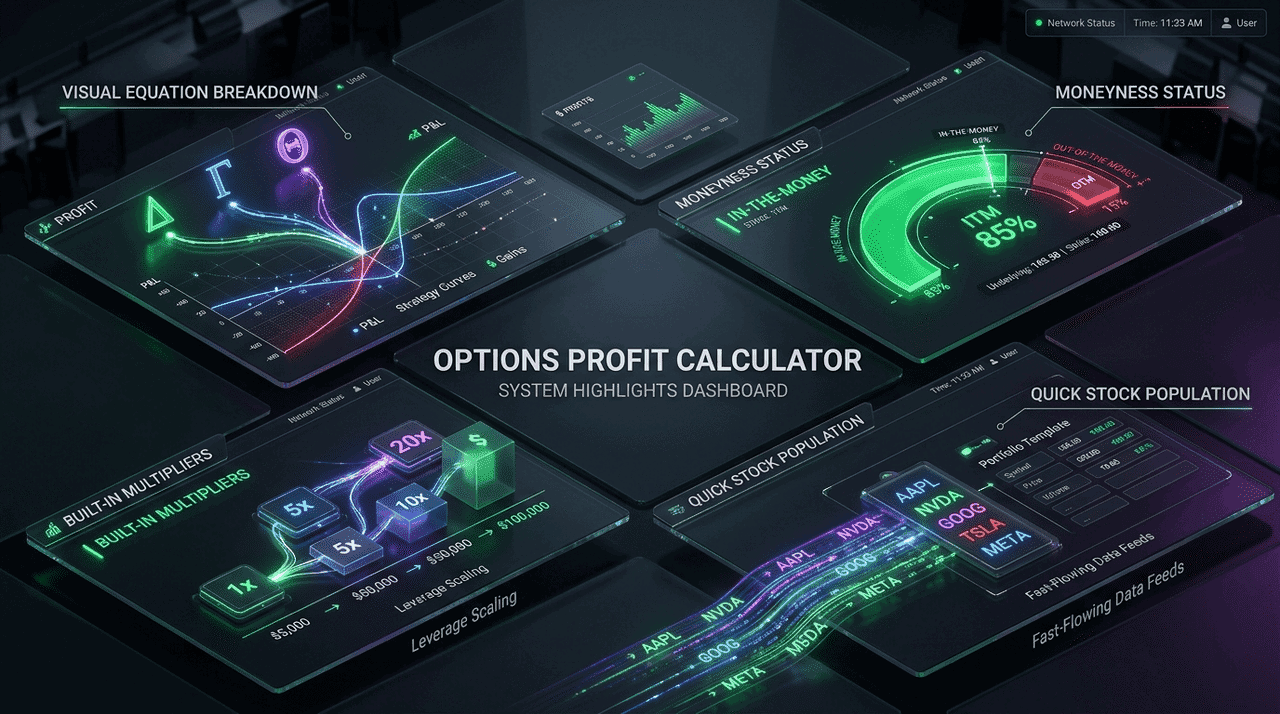
- Visual Equation BreakdownThe Results panel shows the exact math, including intrinsic value minus premium, so you can verify the logic layer by layer.
- Moneyness StatusSee Estimated Profit at Expiration, a clear IN THE MONEY status, and the per-share profit after premium.
- Built-in MultipliersEach contract represents 100 shares. Enter your Contracts Nums and the tool applies the 100x multiplier automatically.
- Quick Stock PopulationOptionally choose a ticker to auto-populate current share price fields and move faster through scenario analysis.
Four steps from thesis to payoff
Step-by-Step Workflow
Run a trade setup through the options profit calculator in four focused steps.
- 1
Select Your Stock (Optional)
Use the top search bar to pick a stock and auto-populate the current Share Price, or leave it blank to enter custom numbers manually.
- 2
Define Option Details
Select your Option Type (Call or Put), then input your Option Price (Premium) and Contracts Nums.
- 3
Set Target Prices
Enter your projected Share Price at expiration and your chosen Strike Price for the trade.
- 4
Calculate
Click the “Calculate profit” button. The options profit calculator instantly displays your total profit or loss alongside the expanded math breakdown.
Built around real trading decisions
Who Benefits From This Platform
This options profit calculator is a practical risk-management asset for three common trading profiles.

Earnings Traders
Visualize how an unexpected earnings gap will impact your premium and overall profitability before the market opens.

Options Beginners
Learn derivatives mechanics safely. The visual math shows exactly how the final numbers are derived.

Active Swing Traders
Map multiple strike prices and contract sizes to find the most capital-efficient setup.
Risk and mechanics, clarified
Common Trading Questions
Q1Why is an options profit calculator essential during earnings?
Earnings reports cause massive price swings. This tool lets you simulate volatile price changes and see potential profit or capital loss.
Q2Does this calculator account for 100 shares per contract?
Yes. It automatically multiplies contract inputs by 100 to reflect market mechanics.
Q3Can I use this as a basic options calculator?
Yes. It can verify the premium cost of a multi-contract trade or provide a deeper gain analysis.
Q4What does At the Money mean?
The share price equals the strike price, so the contract has no intrinsic value.
Q5What does Premium at risk mean?
It is the maximum capital you could lose if the contract expires worthless.
Q6What happens if I close before expiration?
The formulas assume expiration, but you can model target prices to estimate early exits.
Q7Do I enter the option premium manually?
Yes. Enter the exact premium per share for accurate net profit calculations.